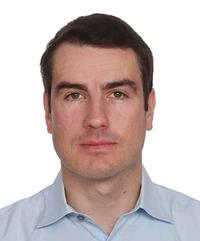
Juergen Rauleder
Born: Germany
Primarily active in: United States of America
From: Leadership Profile
Vertiflite, May/June 2026
Growing up in a small village near Stuttgart, Germany, Juergen Rauleder did not initially set out with a singular focus on rotorcraft or even aerospace engineering. Instead, his path began with curiosity about how machines worked and a willingness to pursue difficult challenges, traits that would eventually lead him across the Atlantic and into one of the world’s leading rotorcraft research communities.
“My dad was a technician working with machines; CNC machines, milling machines, lathes,” Rauleder recalls. “He worked on the shop floor first and later moved into sales for the same machines.” That early exposure to the precision and craftsmanship of German manufacturing left an impression, even if aviation was not yet on the horizon.
Like many students in Germany, Rauleder’s educational path was shaped early. After elementary school, students are recommended for different academic tracks based largely on their grades. Rauleder entered the academically oriented track that prepares students for university study. Yet even then, his future discipline remained open.
“I considered business and other things,” he says. “But aerospace seemed exciting and like a good challenge. I thought, ‘Let’s try aerospace engineering, and if it doesn’t work out, I can still switch.”
That decision led him to the University of Stuttgart, one of Germany’s premier technical universities. The institution offers one of the few programs in Germany where students can study aerospace engineering from the very beginning of their university education.
“The aerospace program at Stuttgart is very highly regarded,” Rauleder explains. “It was also close to where I grew up, so it was a natural choice.”
During his studies he developed strong foundations in fluid mechanics, aerodynamics and thermodynamics, but one particular class would ultimately redirect his career. That course was a rotorcraft aeromechanics class taught by Professor Siegfried Wagner, a former head of aerodynamics at Messerschmitt-Bölkow-Blohm (MBB), which later became part of Airbus Helicopters. “He had a long career in rotorcraft and could connect the fundamental classroom theory to how industry actually applies it,” Rauleder says. “That’s what really hooked me.”
At the time, rotorcraft education opportunities in Germany were limited. A few universities offered isolated courses, but there were no dedicated rotorcraft specialization tracks comparable to those in the United States.
“The University of Maryland, Penn State, and Georgia Tech had rotorcraft centers where you could learn everything, aerodynamics, dynamics, structures, design, etc.” he says. “That just wasn’t possible in Germany at the time.”
Encouraged by Wagner, Rauleder began exploring opportunities in the United States. Wagner reached out to several rotorcraft centers on his behalf, and one response stood out. “Professor Gordon Leishman responded quickly and positively,” Rauleder says. “And that’s how I ended up at the University of Maryland.” Initially, the move was meant to be temporary, stay 6 months, do the master’s thesis research, then defend in Germany. Instead, the experience reshaped his career.
Working with Leishman and the rotorcraft center at Maryland exposed Rauleder to cutting-edge experimental research in rotor aerodynamics. The collaborative research environment and strong connections to industry and government programs proved irresistible. “I got hooked,” he says. “I wanted to do more of it.”
Leishman recognized his potential and offered him the opportunity to remain at Maryland as a doctoral student. What was originally planned as a six-month research visit soon became a four-and-a-half-year journey culminating in a Ph.D. in 2014. “I took all the rotorcraft courses I could and did exciting experimental research in the lab,” Rauleder says. “It was a lot of fun.”
After completing his doctorate, Rauleder returned to Germany for a postdoctoral position at the Technical University of Munich (TUM), that later grew into a senior lecturer position, also leading a research group. There he worked with Professor Manfred Hajek, one of Europe’s leading rotorcraft researchers. At TUM, Rauleder established and grew an externally funded rotorcraft aerodynamics research group with six PhD students at the peak.
>Rauleder secured funding from the U.S. Office of Naval Research (ONR) and the U.S. Army, while also working on major European Union H2020 research initiatives involving institutions such as DLR, TU Delft and the University of Bristol. In 2020, another opportunity emerged, this time bringing Rauleder back to the United States.
A faculty position opened at the Georgia Institute of Technology following the retirement of an aerodynamics professor. Colleagues encouraged Rauleder to apply. “I always keep my eyes and ears open,” he says. “Someone reached out and said, ‘Hey, we have this opening, why don’t you apply?’ So I did.”
Today, Rauleder is an associate professor in Georgia Tech’s Daniel Guggenheim School of Aerospace Engineering, where he also serves as the director of the large Harper Wind Tunnel and as associate director of the Vertical Lift Research Center of Excellence. His research is on the experimental and applied numerical aerodynamics, with a focus on rotorcraft and fixedwing applications. His research in interactional aerodynamics, configuration aerodynamics, aero-propulsive interactions, aeroelasticity and fluid-structure interactions, and real-time flow field computations for piloted flight simulators are critical for design, optimization, efficiency, and safety of aerial vehicles and their operation. See https://sites.gatech.edu/cereal/ for more info on lab and research.
While his work continues to push the frontiers of rotorcraft science and technology, Rauleder says the most rewarding part of his job lies elsewhere. “The greatest joy in the job is working with the students, mentoring them, seeing their growth, and watching them move on to their own careers,” he says.
Several of his former students have already begun establishing their own successful industry or academic careers. “One of my students recently became an assistant professor at Texas A&M,” Rauleder notes with pride. “Seeing them take that step is very rewarding.”
Looking ahead, Rauleder sees several technological developments reshaping vertical flight, particularly electrification, autonomy, and new aircraft configurations emerging from the advanced air mobility (AAM) sector.
“Electric flight is a big enabler,” he says. “Designers now have a lot of freedom, you can place propellers or rotors wherever it suits the vehicle design.”
Hybrid-electric propulsion and hydrogen-based systems may also extend the capabilities of future aircraft, especially as battery limitations constrain fully battery-electric vehicles to smaller ranges.
At the same time, Rauleder believes advances will continue to depend on a combination of computational modeling, experimental testing and real-world flight demonstrations.
“Computational, experimental and theoretical approaches all need to work hand in hand,” he says. “And we still need flight demonstrators. If you don’t take any risk, then you’re stuck.”
That philosophy is especially timely as a new generation of experimental aircraft comes into focus. With DARPA’s X-76 program featured on the cover of this issue, Rauleder sees these kinds of X-planes as essential to advancing the field. “We have seen so many great X-planes, and we learned a lot from them,” he says. “Yes, they can be expensive and carry risk, but with measured risk, you can get far. If you don’t take any risk, then you’re stuck.”
For now, Rauleder is focused on the responsibilities, and opportunities, that come with academia.
“The professor role is one of the most fulfilling things I can think of,” he says. “You’re educating the next generation of aerospace engineers, and that impact lasts much longer than your own career.”
Whether he remains in academia for decades to come or eventually explores other paths, Rauleder is certain about one thing: the next generation of engineers will define the future of vertical flight.
“Our job is to excite them about engineering and equip them with the right skills to help them develop great things,” he says. “That will carry on much longer than any one of our careers.”