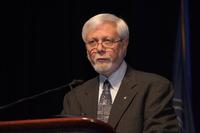
John M. Davis
Born: United States of America
Primarily active in: United States of America
John Davis is an American rotorcraft engineer, researcher, technology manager, and longtime leader within the vertical flight community whose career spans more than five decades. Best known for his contributions to rotorcraft flight dynamics, simulation, conceptual design, technology planning, and research management, Davis played a significant role in shaping many of the analytical tools, design methodologies, and technology development processes that influenced modern military and civil rotorcraft. His career included formative years at Bell Helicopter, followed by nearly 35 years with the U.S. Army's rotorcraft research organization at NASA Ames Research Center in California, where he helped guide some of the Army's most important rotorcraft technology initiatives.
Davis is also widely recognized for his extensive service to the Vertical Flight Society (formerly the American Helicopter Society), where he served in numerous technical and leadership positions, including Technical Director. In recognition of his contributions to the Society and the broader rotorcraft profession, he was named an Honorary Fellow of the Society in 2009.
Early Life and Education
John Davis grew up in Indianapolis, Indiana. He attended Culver Military Academy in northern Indiana, an experience that helped prepare him for admission to the Massachusetts Institute of Technology (MIT), where he pursued studies in aeronautics and astronautics.
While attending MIT, Davis developed an interest in rotary-wing aircraft. During college he sought summer employment and, largely through initiative and circumstance, applied to Bell Helicopter in Fort Worth, Texas. Bell hired him based on his resume, beginning a professional relationship that would define the first decade of his career and establish his lifelong connection to the rotorcraft industry.
Davis graduated from MIT in 1967. Despite receiving numerous employment offers from major aerospace companies, he had already decided that Bell Helicopter offered the most interesting opportunities and chose to begin his professional career there.
Bell Helicopter Years
Davis joined Bell Helicopter in 1967 during a transformative period in rotary-wing aviation. The Vietnam War had accelerated helicopter development, and Bell was at the forefront of military rotorcraft innovation.
At Bell, Davis worked in the areas of flight dynamics, stability and control, simulation, and rotorcraft analysis. During this period he became involved in the development of increasingly sophisticated digital flight simulation capabilities, helping advance Bell's ability to predict and analyze aircraft behavior before flight testing.
One of his early mentors was Chuck Livingston, another MIT graduate who had played a key role in hiring him. Livingston's work in mathematical modeling and simulation would later influence some of the analytical tools Davis would continue developing after leaving Bell.
Throughout his nine years in Fort Worth, Davis gained broad experience in helicopter engineering and worked alongside many of the individuals who would become influential figures in the rotorcraft field. He contributed to the development and application of simulation methods at a time when digital computing was beginning to transform aerospace engineering.
By the mid-1970s, however, Davis sought a new challenge. Drawn by the opportunities and lifestyle of Northern California, he decided to relocate to the San Francisco Bay Area. The move would prove professionally and personally significant. Within weeks of arriving in California, he met his future wife, Betsy. The two would remain together for decades.
Joining the Army Research Community
In 1976, Davis joined the U.S. Army rotorcraft research organization at NASA Ames Research Center, then known as the Aeromechanics Laboratory. At the time, the organization was still relatively young but already developing a reputation as one of the world's premier rotorcraft research institutions.
The Army-NASA partnership at Ames combined government researchers, military requirements developers, and industry collaborators in a unique environment dedicated to advancing rotorcraft science and technology. Davis arrived at a time when many of the organization's foundational figures were still active, allowing him to work directly with several of the pioneers who established modern rotorcraft research.
Among the individuals who most influenced his career were Andy Kerr, Mike Scully, Dave Key, and Bob Ormiston. Davis often cited Kerr and Scully as two of the colleagues with whom he worked most closely throughout his Army career.
Initially, Davis worked for Dave Key, who would later become widely known as the "father of ADS-33," the military handling qualities specification that transformed rotorcraft flight control design. Soon afterward, Andy Kerr recruited Davis to support development of one of the Army's most ambitious analytical efforts.
2GCHAS and Rotorcraft Analysis
One of Davis's most important technical contributions involved work on the Second Generation Comprehensive Helicopter Analysis System (2GCHAS), commonly referred to as "2-G Charlie."
2GCHAS represented a major step forward in comprehensive rotorcraft analysis. At a time when helicopter design relied heavily on wind tunnel testing and empirical methods, the Army sought to develop analytical tools capable of accurately predicting rotorcraft performance, loads, vibration, and dynamics.
Working with Kerr, Ormiston, and others, Davis helped advance the analytical frameworks that eventually evolved into the Rotorcraft Comprehensive Analysis System (RCAS), which remains one of the most important rotorcraft engineering tools ever developed.
The significance of this work extended well beyond individual aircraft programs. RCAS and its predecessors fundamentally changed how rotorcraft are designed, enabling engineers to evaluate concepts virtually, reduce risk, and accelerate development. Many of today's rotorcraft design and analysis practices trace their lineage to these pioneering efforts.
Flight Simulation and Handling Qualities Research
Another major area of Davis's work involved flight simulation and handling qualities.
Shortly after joining the Army research organization, Davis became involved in studies examining pilot response to control system failures. One effort stemmed from a Bell 214 accident that occurred during hard-over control system testing. Researchers sought to understand how much time a pilot had to recognize and react to a sudden control system failure before loss of the aircraft became unavoidable.
Using the Flight Simulator for Advanced Aircraft (FSAA), Davis helped develop and refine simulation models used to study pilot response and aircraft controllability. During this work, he identified modeling assumptions that improved the accuracy of the simulation and enhanced confidence in the resulting analyses.
These efforts contributed to a broader understanding of rotorcraft handling qualities, pilot workload, and flight control system design—areas that would remain central to Army rotorcraft research for decades.
Conceptual Design and Advanced Rotorcraft Concepts
As his career progressed, Davis became increasingly involved in conceptual design and advanced aircraft studies.
Working closely with Mike Scully and other leaders at Ames, Davis helped establish and refine methodologies for evaluating future rotorcraft concepts. The conceptual design organization became known for its ability to rapidly assess innovative aircraft configurations and explore the tradeoffs among performance, cost, technology readiness, and operational utility.
Among the major initiatives associated with this period was support for the Light Helicopter Experimental (LHX) program, which eventually produced the RAH-66 Comanche. The conceptual design team provided analyses that informed Army decision-making regarding future rotorcraft technologies and capabilities.
Over time, Davis became one of the Army's leading advocates for disciplined conceptual design processes, helping create methods that linked technology investments directly to future operational capability.
National Rotorcraft Technology Center
Perhaps one of Davis's most influential leadership roles came through the National Rotorcraft Technology Center (NRTC).
Established during the 1990s, NRTC sought to strengthen collaboration among government, industry, and academia while accelerating rotorcraft technology development. The organization became a key mechanism for transitioning research into practical capability.
Davis served as the original Deputy Director of NRTC. In this position he helped shape the center during its formative years and played an important role in establishing the partnerships and processes that would define its success.
When leadership transitions later required a different Army-NASA management arrangement, Davis returned to technical and managerial responsibilities in conceptual design. Nevertheless, his contributions during NRTC's formative years helped establish an organization that continues to influence rotorcraft technology development today.
Engineering Management and Technology Leadership
Later in his career, Davis transitioned from primarily technical roles into engineering management.
While continuing to participate in technical activities, he increasingly focused on leading teams, managing research portfolios, and guiding strategic technology investments. He became known as a thoughtful manager who understood both the technical and organizational dimensions of research and development.
Unlike some of his contemporaries who remained deeply specialized technical experts, Davis often described himself as balancing management responsibilities with technical engagement. This ability to bridge the two worlds proved valuable as Army aviation research became more complex and increasingly dependent on collaboration among diverse stakeholders.
Throughout this period, he maintained a strong commitment to conceptual design, technology planning, and long-range rotorcraft capability development.
Contributions to the Vertical Flight Society
Parallel to his professional accomplishments, Davis devoted substantial time and energy to the Vertical Flight Society.
Over several decades he became one of the Society's most active volunteers, contributing to technical committees, conferences, publications, scholarship activities, and organizational leadership.
His service included leadership roles within the Technical Council and ultimately service as Technical Director. In these positions he helped shape the Society's technical direction, strengthen its conference programs, and foster engagement among engineers, researchers, government personnel, and students.
Davis was particularly valued for his ability to connect generations of rotorcraft professionals. Having worked alongside many of the field's pioneers while also mentoring younger engineers, he served as an important bridge between the industry's past and future.
His efforts helped preserve institutional knowledge and ensure that lessons learned from decades of rotorcraft development remained available to new generations of engineers.
Recognition and Legacy
Over the course of his career, Davis earned widespread respect throughout the vertical flight community. Colleagues consistently recognized his technical expertise, collaborative leadership style, and commitment to advancing rotorcraft technology.
His contributions span several of the most important developments in modern rotorcraft engineering, including:
- Advancement of rotorcraft flight simulation methods.
- Development of comprehensive analysis tools that evolved into RCAS.
- Research in handling qualities and flight control systems.
- Conceptual design methodologies for advanced rotorcraft.
- Support to major Army aviation modernization efforts.
- Leadership during the establishment of the National Rotorcraft Technology Center.
- Decades of volunteer service to the Vertical Flight Society.
Perhaps most importantly, Davis's career illustrates the unique value of the Army-NASA rotorcraft research partnership that existed at Ames Research Center for many decades. Through his technical work, leadership, and mentorship, he helped shape a generation of rotorcraft technology and contributed to the analytical foundations upon which much of modern vertical flight engineering is built.
Today, John M. Davis remains recognized as one of the key contributors to the rotorcraft research community that flourished at NASA Ames and as a respected leader whose influence continues to be felt across the vertical flight profession.