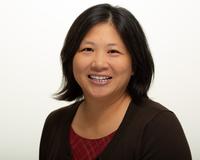
Catherine Cheung
Born: Canada
Primarily active in: Canada
From: Leadership Profile
Vertiflite July/August 2026
Catherine “Cathy” Cheung’s leadership story begins not with helicopters but with a broader pattern: curiosity, discipline and motion. She describes growing up in Toronto in a fairly traditional Chinese family, with a father who was a doctor in a household culture that emphasized the importance of math and science. But the portrait is not one-dimensional. Alongside science, she remembers a second constant: sports. “Sports is my other great passion,” she says, a small line, but an important one, because it helps explain the style of leader she became— collaborative, competitive and attracted to team achievement as much as individual expertise.
That combination of openness and drive shaped her university choice. Cheung says she did not begin with a fully fixed professional identity; instead, when it came time to apply, she chose several possible directions, including physiotherapy and a pre-med-style arts-and-science option. The door that opened most clearly was engineering at the University of Toronto. She chose the Engineering Science program because it gave her room to decide later, and because the aerospace option struck her as “the cool thing to do in engineering.” The detail matters: From the start, her route was less about rigid certainty than about backing herself into a demanding environment where options stayed alive.
Even there, she did not become the caricature of the all-lab, no-life engineer. She says she kept sports central at university, not as a side note but as a sustaining force. She played intramurals season after season, basketball, volleyball, soccer and later rowing. Cheung’s professional identity was not built just on technical rigor but also on rhythm, teamwork and persistence under pressure. Those traits later show up again in the way she talks about research programs, committees and long-horizon goals.
Her early journey in aerospace was practical as well as academic. During university, she completed a 16-month coop at Pratt & Whitney Canada in Mississauga, and she also found aerospace and engineering work in the summers. Yet her graduate research moved in an interesting and different direction. Instead of staying narrowly in aerospace, she entered a University of Toronto graduate environment where her thesis explored low-level vision and self-organizing computational models. In retrospect, that apparent detour now looks less like a diversion and more like preparation. Cheung recognized that the modeling, data and machine-learning logic she was using then would later connect naturally to aircraft-health data, fatigue assessment and digital-twin thinking.
Her entry into the National Research Council of Canada (NRC), that nation’s largest government research and innovation organization, came through a classic combination of network, timing and readiness. Cheung recalls that a lab-mate connected her to Dr. Roy Hewitt, an NRC researcher in structural integrity who was nearing retirement and looking for a successor. She was finishing her Master’s in a difficult job market (she dates that period to 2002, during the dot-com bubble), and Hewitt brought her to Ottawa for an interview. She joined the NRC’s structural integrity group and began work in full-scale testing, including control algorithms intended to make fatigue tests run faster. That is an important early-career pivot: she entered through structures and testing, not through a preexisting rotorcraft identity.
Australia changed that. Cheung describes how growing defense interest in helicopter work led to an opportunity to spend roughly 14 months working with Australian counterparts at the Defence Science and Technology Organisation (DSTO) in Melbourne. Until then, she says, much of the lab’s defense work had been fixed-wing focused. Australia became the point where helicopters moved from peripheral topic to central domain. There, she was exposed to helicopter structures, loads and usage monitoring, and aircraft such as Sea Sprites, Sea Kings and Black Hawks. Just as importantly, it was also the moment when the professional became personal. “One of the many positive outcomes” of that Australia trip, she says, was that “my husband’s Australian, and that’s where we met.”
The DTSO chapter also explains her enduring affection for the country. She says her family still returns regularly, and Australia stayed part of her technical life through recurring conferences, especially in HUMS-related circles. That makes Australia more than a travel anecdote; it’s a hinge between Cheung’s first aerospace identity and her mature rotorcraft identity. It gave her helicopters, relationships, technical community and a wider professional horizon.
Back in Canada, that rotorcraft path deepened. Cheung says that after Australia she worked almost exclusively in loads and usage monitoring, much of it tied to machine learning. She explicitly connects that work to digital-twin ideas and individual-aircraft tracking, and she’s publishing her findings. At Forum 82, she was the presenting author on “Modeling Streaming vs Batch Data in a Common, Open Data Exchange Format for HUMS” and on “Improving Regime Recognition Model Validation with Labeled Flight Test Data and Visualization Tools.”. She also won best paper at Forum 81 in the Integrated Vehicle Health Management (IVHM) session, paper titled “Feature Selection and Gamma Test for Improved Load Estimation Models.”
About two years ago, in 2024, Cheung became the focus-area lead for Defense Platform Sustainment as a senior research officer at the NRC. In her own description, that means overseeing the projects under that umbrella, carrying revenue targets, allocating budget across project managers, reporting outcomes upward and engaging with defense partners. The most revealing part is not the administrative list; it is her explanation of what attracts her to it. She likes the chance to set technical strategic direction, to group individuals working on different aspects and move them “forward in the same direction” toward a larger five-year goal. That is the approach of a research leader, not merely a subject-matter expert.
Today, Cheung continues to give back to the vertical flight community through her volunteer leadership with the Vertical Flight Society. She serves on the VFS Technical Council as Deputy Technical Director for Systems Engineering, overseeing the Society’s Systems Engineering Tools and Processes, IVHM and Safety Technical Committees. In those roles, she helps guide technical programming, paper reviews, awards and the exchange of knowledge across the vertical flight community.
Her contributions have also been recognized through several Best Paper Awards. Cheung is also an active supporter of VFS initiatives such as Women of Vertical Flight (WOVEN), which helps foster a more inclusive and connected professional community. She is also an associate editor for the Journal of the American Helicopter Association.
Whether helping shape national research priorities at the NRC or supporting the professional development of engineers and researchers through VFS, Cheung remains committed to advancing aerospace technology through collaboration, technical excellence and service to the broader community. While she has already built an impressive career spanning research, leadership and international collaboration, she speaks less about personal achievements and more about creating opportunities for others to succeed. That outlook has defined her career, from the student athlete who embraced challenges on and off the field, to the young engineer who discovered helicopters on the other side of the world, to the research leader helping guide Canada’s aerospace future. Whatever comes next, it is likely to involve the same qualities that have shaped her journey so far—curiosity, teamwork and a passion for helping both people and technology reach their full potential.