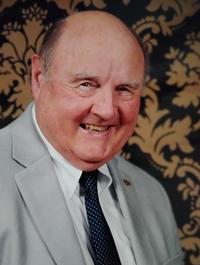
James Ronald Mecklin
Born: United States of America
Primarily active in: United States of America
1931-2026
Ron Mecklin, USAF Test Pilot
James Ronald "Ron" Mecklin was born in Marfa, Texas, on October 6, 1931, he served in the United States Air Force before enjoying a long career with Boeing Helicopters as a flight test pilot. Ron Mecklin joined the US Air Force in 1954 and flew helicopters for six years — mostly the H-21B helicopter in Tennessee and Hokkaido Island, Japan; in Okinawa, he was flying to radar sites and then in Cape Cod, Massachusetts, flew out to Texas Tower radar sites off shore. He served as a maintenance test pilot for the unit’s H-21Bs for almost three years.
In 1961, he joined Boeing Vertol as a company test pilot and started flying the twin-turbine-powered Vertol-107 series. He served as copilot on the initial test flight of the HRB-1, which subsequently became the CH-46A. He flew this aircraft throughout its developmental program, doing performance testing, stress and motion testing and structural demonstrations. He eventually became the CH-46 project test pilot and participated in the development of the CH-46 -D and -E models.
In the later ’60s, when the test phase of the H-46 series wound down, he started flying the Model 347 — a stretched CH-47 that eventually had a tilt wing installed. This wing was installed and had a G-sensitive flap system that deployed flaps to offload the rotor system while maneuvering.
In 1971, he headed up a flight demonstration of a modified automated flight control system (AFCS) to the Japanese Self Defense Force in Japan and then went to Singapore to arrange a demo program for their armed forces. He came back after five months in the Far East to continue a flight demonstration of the Model 347 for Pentagon officials, which had begun while he was away. He continued flying the CH-47C in the early ’70s and spent several months in Spain training Spanish Army pilots to fly their newly acquired Chinooks.
In 1974, he went to Long Island, New York, to participate in the Utility Tactical Transport Aircraft System (UTTAS) competition flying Boeing’s entrant, the YUH-61. He flew the strain survey and in the structural demonstration of that aircraft and then trained US Army pilots at Ft. Rucker, Alabama, and Ft. Campbell, Kentucky.
In the late ’70s, Mecklin was involved in flight testing composite rotor blades for the CH-47 and later on for the CH-46 helicopters. At this time, he was also designated as the Chinook project test pilot.
He flew the first CH-47D on its initial flight and during the flight qualification trials, concentrating on the stress and motion program and structural demonstration. The next several years, he was involved in training US Army pilots to fly the -D model and continued working in systems refinement.
In the early ’80s, he was involved with the Royal Air Force’s (RAF) HC-Mk1 program and ftrainedthe Boscombe Down test pilots and initial group of instructors in RAF 240 Squadron at RAF Odiham.
In 1985, he got involved with special operations where they were in the process of modifying several Chinooks with a Rockwell Collins integrated cockpit and flight-control system. This system allowed the coupling of the flight controls to various navigation systems, including GPS. This configuration eventually became known as the MH-47D. In addition to this program, he spent several months in Taiwan training their army pilots to fly their newly acquired BV Model 234s.
In the later ’80s, he was involved with the Boeing Model 360 and became the project test pilot for this developmental program that used composite materials for most of the aircraft — fuselage, rotor hubs, rotor blades, aft vertical rotor shaft and a new, integrated Bendix cockpit display system that used CRT displays for all functions.
In 1989, he was involved in the RAF’s new version of the Chinook called the HC-MkII. He flew the qualification program at Boeing and then trained the Boscombe Down pilots in the new configuration and then went to RAF Odiham to train the 240 Squadron instructor pilots in the MkII.
In the early ’90s he was involved in a classified program that required three pilots at Boeing Helicopters to qualify in the AH- 64 Apache. Ron was involved in the developmental program for the Special Operations Model MH-47E. He flew the initial flight and was involved in most of the developmental flight program for that aircraft. After his retirement from Boeing in 1994, Ron stayed an active member of the then-AHS, and later VFS Philadelphia Chapter. He could always be counted on to attend dinner meetings and ask presenters the toughest questions of the evening.
Ron passed on January 15, 2026, at the age of 94. He leaves behind a legacy of two children, four grandchildren, and ten great-grandchildren and is survived by his brother, Donald Mecklin.
Source: In Memoriam, Vertiflite July/August 2026