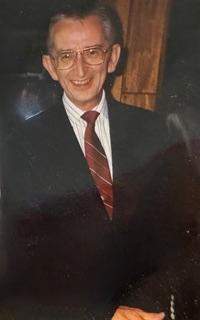
Francis Joseph McHugh
Born: United States of America
Primarily active in: United States of America
1935-2026
Francis Joseph McHugh, Aerospace Engineer
Francis “Frank” Joseph McHugh was born in Hazelton, Pennsylvania, in 1935. Frank studied engineering at Penn State University. Following his graduation from Penn State in 1957 with a BS in mechanical engineering, his illustrious contributions to the industry began at Martin Marietta, followed by a long and storied career at the Vertol Aircraft Corporation, Boeing Vertol Company and The Boeing Company. McHugh was respected nationally and internationally as an expert in aerodynamics and partnered over the years with colleagues throughout the industry, government and academia. McHugh was a key figure in advanced rotor system technology, specializing in helicopter aerodynamics, rotor performance limits and tiltrotor aircraft. His major contributions included the study of rotor limits in high-speed flight. The examination of the lift and propulsive force limits of conventional helicopter rotors at high speeds led to the development of the McVeigh- McHugh thrust boundary limit to describe dynamic stall and supersonic drag boundaries. He also partnered on early efforts to utilize higher harmonic pitch to reduce vibratory loads as well as studying various blade design features, such as twist distribution and tip shape to improve performance and reduce vibration. He was part of a team looking at growth options for the CH-47 Chinook, including the winged Model 347. Frank McHugh’s theoretical and experimental work is documented in numerous technical papers and journal publications.
McHugh led the Boeing aerodynamics organization as well as advanced rotor system technology programs at Boeing Vertol through the 1970s. In the early to mid-1970s, he worked on Boeing’s entry in the Army’s UTTAS competition (YUH- 61A), which was won by Sikorsky and became the Blackhawk helicopter. This catalyzed advances in helicopter technology, integrating new materials and design philosophies into rotorcraft.
Following the failure of Operation Eagle Claw (Iran hostage rescue mission), McHugh was part of a study to understand the shortcomings of the current fleet in similar missions and what requirements were needed in a new aircraft. This eventually became the JVX Program and the V-22 Osprey.
Following Boeing’s teaming with Sikorsky on the LHX program, Frank was a key part of the “Gang of Six” who oversaw the many trade studies that led to the final aircraft configuration. His technical knowledge and ability to work across company boundaries were key to the eventual award of the contract for the RAH-66 Comanche.
Frank retired from Boeing in 1990 after an impressive career in aerospace. In retirement, Frank turned his love of jewelry making into a small business venture by selling at craft shows.
He also enjoyed traveling with his family, enjoying trips to Italy, Ireland, Hawaii, New England, California and the Pacific Northwest. Frank McHugh was a devoted family man and leaves behind his wife, Rita; children, Patrick, Lisa, Eileen and Timothy; and granddaughter Caitlin Rose Ward. Frank
McHugh passed away on March 18, 2026, at age 90, surrounded by his family.
Source: In Memoriam, Vertiflite July/August 2026